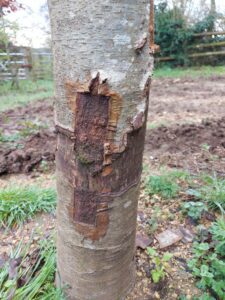
In a recent project, groundworkers from a third party tried to lift a mature beech tree by wrapping a choke around the base of the trunk. This is extraordinarily bad practice at the best of times, but during the spring this is especially bad as sap is being pumped up the trunk, making the vascular tissue beneath the bark very slippery and susceptible to damage. In this case, the choke created a wound roughly 10cm wide around the entire circumference of the tree. This is known as ringbarking or girdling.
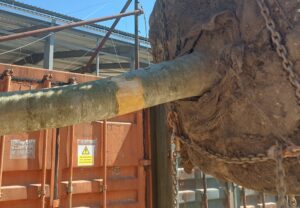
Why Ringbarking Is Bad
The trunk of a tree is made up of different sections, each dedicated to specific functions.
Heartwood – the innermost part of the trunk. This wood is dead and its main function is structural.
Sapwood – this is made up of vessels, called xylem, which transport water and some nutrients from the roots up to the canopy of the tree.
Cambium – This is where new tissue grows from. It is found between the xylem and the phloem and is generally bright green in a healthy plant.
Inner bark – This is made up of vessels, called phloem, which transport the sugars created by the leaves around the rest of the tree.
Outer bark – a layer of old phloem which protects the tree from pathogens and physical damage.
When a tree gets ring-barked, the phloem and the cambium are stripped away meaning that the tree has no way of sending the sugars back down to the roots, meaning that over time it will die. If the ringbarking is severe then even the xylem may be gone, meaning that no water can make it up to the tree canopy.
What We Did
If the wound is only small, then there is a chance that the tree will be able to heal over the gap itself, however, a gap of 10cm is far too big for this to happen, and so we attempted a bridge graft.
Bridge grafting is when a strip of bark is used to bridge the gap. Firstly, the bark used has to be compatible – this is because of the way the vascular system is arranged differently in different species of tree. To ensure compatibility, we cut bark from further up the same tree, although as long as the bark is from the same species, it shouldn’t be a problem.
For the graft to work, the joins between the base, bridge and top all have to be as tight together as possible, so the first task was to tidy up the raggedy edges of the wound.
With this done, a strip of healthy bark was cut to closely match the dimensions of the hole. This was then inserted into the gap so that is fitted snuggly and held in place with flexi-tie and the wounds were sealed with grafting wax.
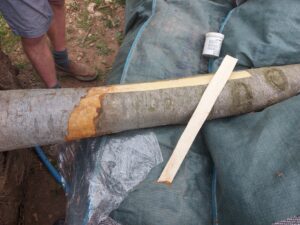
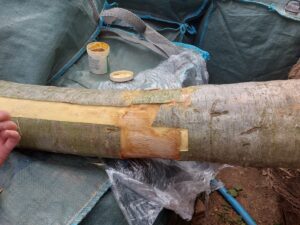
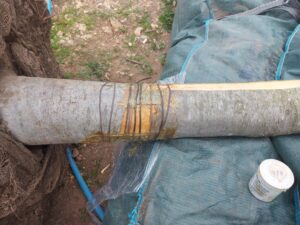
We repeated this process a couple of times so that there were bridges around the circumference of the trunk.
The perfect time for grafting is late winter before the sap starts rising. Unfortunately, this was not an option for us as the damage took place in May – exactly the wrong time, as in late spring the leaves are growing quickly and need all the water and nutrients they can get.
With the bridges in place, all that was left to do was wait.
2 Months On
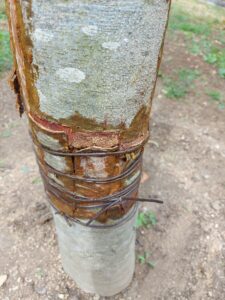
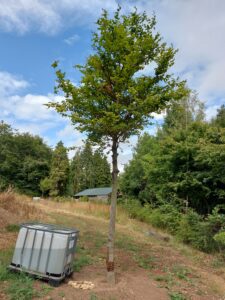
The wounds have started callusing over, however there are no signs that the grafts have taken. The canopy of the tree is still lush and green, showing that the xylem tissue was not damaged, but the real test will come next spring. If the buds don’t break, or if they start to break but halt midway through coming into leaf, then it is a sure sign that sugars produced by the leaves the year before couldn’t be stored and therefore couldn’t be sent back up to the canopy.
10 Months On
It is still not clear if we have been successful. Unfortunately, the grafts have not taken, and so have been removed as they were only creating a habitat for woodlice. The areas underneath the grafts have created a large amount of callus, however there is no obvious place where the top and bottom have healed together.
The buds should be breaking soon, so it won’t be long until we find out.